
“In today’s news: Tesla shareholders approved a $46 billion dollar pay package for Elon Musk . . .the largest pay package in the history of . . .”
Angrily, I turn off the car radio as our car rolls to a stop beside the Varsity, an icon of Atlanta history dating back to 1928. We have pulled onto busy North Avenue after a lunch of greasy onion rings, chili dogs, and peach pies. Full, relaxed, and driving home from a three-day mini-vacation, we have just commented on the dilemma of homeless folk sleeping in Olympic Park in front of our hotel.
I sputter, “Think how many hungry and homeless people could benefit from $46 billion dollars if we invested that in providing food and shelter for . . . “
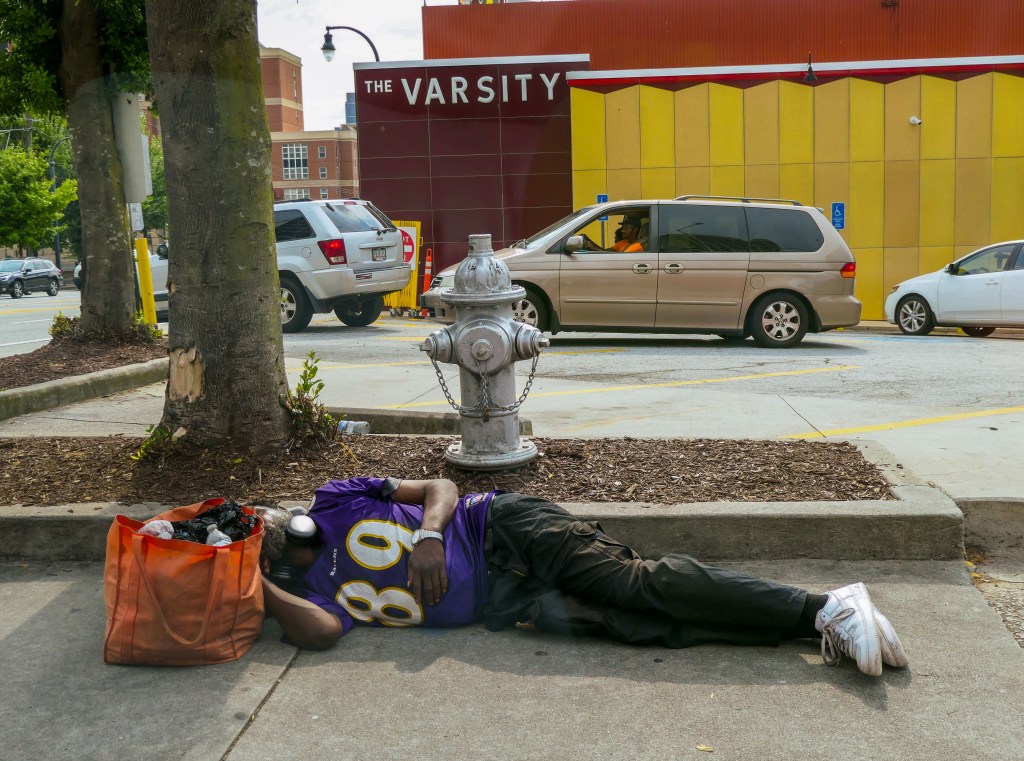
I stop mid-sentence, speechless. As if on cue, a man’s body lies stretched out on the sidewalk in front of a fire hydrant beside the Varsity parking lot, a bag of his belongings set neatly beside his head. The body is dressed in jeans, sneakers, and a purple sports jersey emblazoned with the number 89, one arm curled under his cheek as if settled in for an afternoon nap. Just as I wonder if he is hurt, or dead, he moves a foot slightly, then adjusts an arm; he is alive. Relief. Just another homeless man in downtown Atlanta.
The light changes, horns blast behind us, we move on, but something about the man and his choice of bed have upset me. So, instead of calling 911, I quickly grab my camera and, without concern for focus or lighting, click just as our car pulls away.
Later, at home I upload the photos to my computer and wonder if perhaps I should have called 911. Was he sleeping or sick? Or both?
As I tag the photo “Varsity Man” and begin to edit the image, uneasy thoughts flicker and I enlarge the image. The man has no obvious injuries, but something about the juxtaposition of his concrete bed and the world’s largest drive-in restaurant in the background seems simultaneously tragic yet normal.
Never, in decades of visiting the Varsity, have I seen a homeless person lying on the sidewalk while afternoon traffic whizzes by, oblivious to the geography of his bed. Were the homeless there and we never noticed? Why am I disturbed by this photo?
Even editing the image becomes problematic. If I remove the human image, the photo loses all meaning and becomes just an ordinary street scene. Add the sleeping man and the meaning changes. The power of choice is mine. But what about the subject of the photo? What choices does he have?
Several months later, I still grapple with why this particular image remains embedded in my brain. This is not the first time I’ve seen someone sleeping on a sidewalk, under a bridge, or in a street.
In recent years a group of homeless/houseless folks set up camp in a culvert by I-20 at the end of the street where my 90-year-old mother lived. They often raided her garbage cans and I would be annoyed. Sometimes one would sleep in her car – leaving behind the stale odor of cigarette smoke. I would feel anger, an almost righteous indignation at their invasion.
What about this particular photo disturbs me now? Has this particular image changed my perception of what the Varsity represents? And by extension my perception of reality?
For most of my generation, the Varsity has represented an illusion, an idyllic mid-20th century period when postwar America believed in the American Dream. A nostalgic time when hungry college kids at nearby Georgia Tech flocked to the Varsity to pick up local girls eager to meet future engineers. An era when families took Sunday drives that ended downtown at the Varsity where they splurged on chili dogs, slaw dogs, and onion rings. A time when after ball games or church, or shopping, hungry Atlantans descended on the Varsity for a quick meal, or peach pies and a dose of nostalgia dripping from the “Whatta ya have, Whatta ya have” of smiling workers.
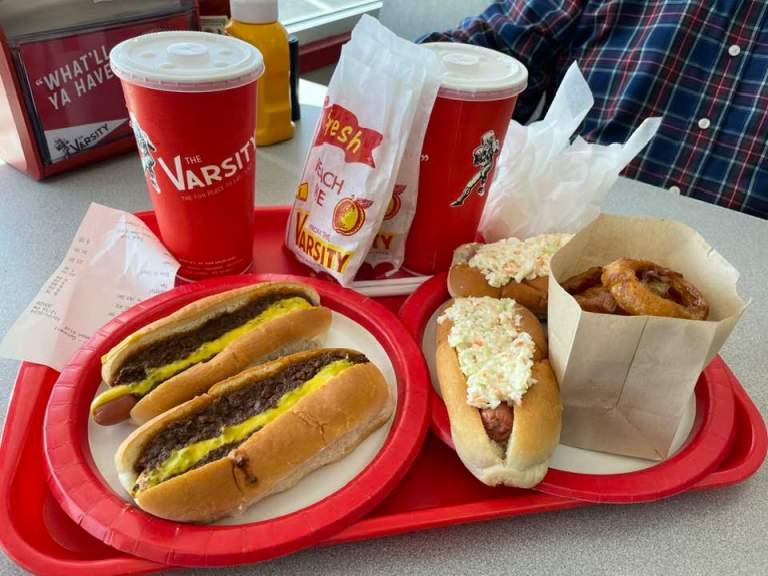
For almost 100 years, The Varsity has been Atlanta’s icon, our mecca. An oasis where rich and poor, black and white, old and young eat and drink together, oblivious of cultural and social status. A place where, after decades of shifting homes, jobs, marriages, and deaths, Atlantans can return to recharge and remember what Atlanta was before it outgrew itself.
Now, several months later, I am still haunted by the image of one man sleeping on the sidewalk by the Varsity. He has disrupted my nostalgia.
Maybe the problem is that nostalgia is fickle; filled with memories and illusions uncolored by notions of race and social status. Until, on a warm sunny June afternoon, the image of the Varsity Man disrupted my illusions.
How could I/we not have seen the irony of black-skinned Varsity carhops in pre-1960’s Atlanta jumping on white-skinned folks’ cars and placing a numbered card on the windshield to stake their claim for a $2 tip. Or the irony of dark-skinned counter workers serving up trays of food to light-skinned customers as they shouted “Whatta ya have, Whatta ya have” for minimum wage and no tip.
Today, folks of all shades and colors visit the Varsity. Carhops long ago became obsolete. Those who work the counters are more diverse, but the economic disparity between those who cook the food and those who eat the food has not changed.
Despite the gaggles of politicians with promises and posturing, we fail to acknowledge that some of the folks curating our nostalgia may be poor, sick, wounded, underpaid, or hungry folk who cannot afford the luxury of homes, beds, chili dogs, or peach pies. And sometimes they may sleep in cars, on sidewalks, or under bridges. Poor is color blind.
So, when I look at this photo of the anonymous Varsity Man, I am not annoyed by his homelessness. I am sad and angry. I am sad for the loss of my Varsity illusion, and angry at the disparity between a $46 billion dollar pay-package and the reality of homelessness and poverty.
 Jo Anne Harris Rowland